Introduction
Thailand has emerged as a strategic node in the global zinc oxide supply chain. In 2026, the global zinc oxide market spans approximately 1.8-2.1 million metric tons annually, valued at THB 85-100 billion, with prices fluctuating between THB 90,000-162,000 per metric ton depending on grade and region.
Thailand positions itself as a mid-sized regional producer rather than a low-cost heavyweight like China or India, competing on responsiveness, traceability, and specialty-grade capabilities. Over the past five years, Thai refiners and chemical manufacturers have invested selectively in vertical integration, primarily to serve internal demand in rubber, coatings, and personal care.
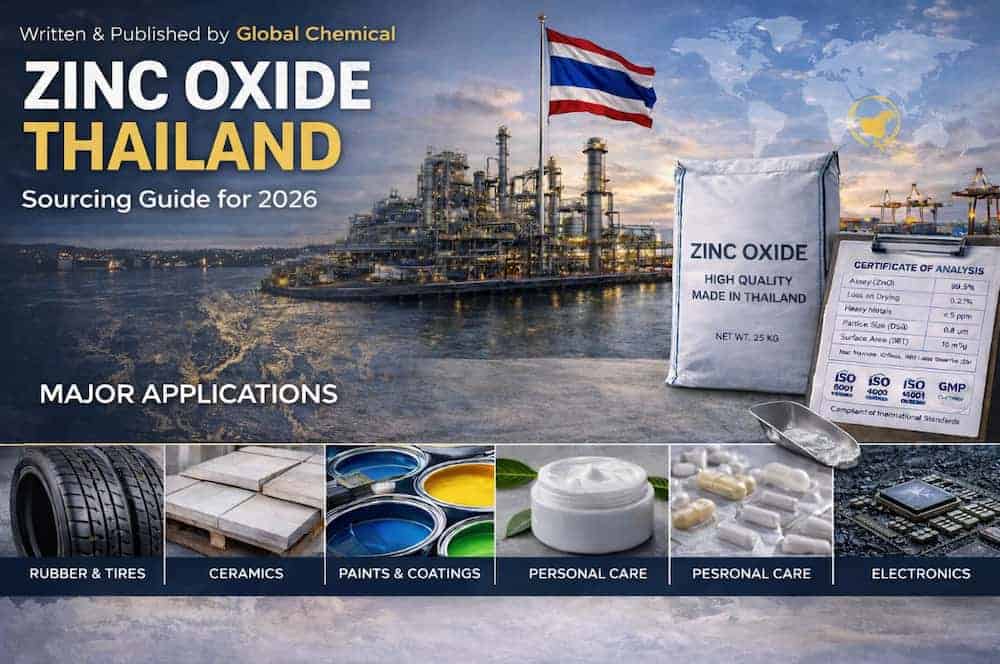
This guide provides actionable insight on zinc oxide in Thailand—market snapshot, production capacity, quality standards, application requirements, and sourcing steps for 2026.
Thailand Market Snapshot
Production Footprint
| Factor | Details |
| Location | Eastern Economic Corridor, Rayong and Chonburi |
| Scale | Single-digit kilotonnes per year |
| Grade Focus | Precipitated ZnO for cosmetics/pharmaceuticals; milled/treated grades for rubber/plastics |
| Specialization | Value-added processing, surface treatment, micronization, custom milling |
Thai producers emphasize value-added processing rather than bulk commodity pricing. Suppliers often accept smaller minimum order quantities than global majors which is useful for trialing formulations without committing to container loads.
Domestic Consumption And Export Dynamics
| Industry | Share | Notes |
| Rubber & Tires | Largest | Thailand is among the world’s leading natural rubber processors; ZnO is critical activator in rubber vulcanization |
| Ceramics | Significant | Domestic ceramic producers require consistent purity |
| Personal Care | Growing | Preference for locally sourced cosmetic-grade ZnO for sunscreens and baby products |
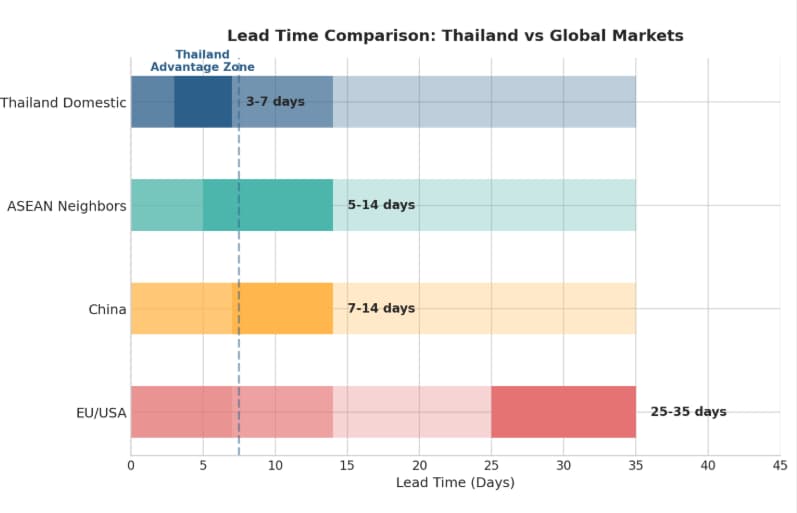
Export patterns: Thai exports target ASEAN neighbors, Japan, and Southeast Asia—reducing transit time and freight cost for regional buyers.
| Destination | Lead Time |
| Thailand Domestic | 3-7 days |
| ASEAN Neighbors | 5-14 days |
| China | 7-14 days + customs |
| EU/USA | 25-35 days |
Supplier Types
| Type | Profile | Best For |
| Integrated Refiners | Zinc smelting/trading operations producing standard grades | Steady supply, consistent monthly volumes |
| Specialty Processors | Particle-size control, surface treatments, certified cosmetic/pharma grades | Product performance, custom specifications |
| Toll Processors | GMP-like environments for private-label dispersions (e.g., sunscreen premixes) | Custom formulations, small-batch production |
Quality & Certification
Thai producers increasingly adopt international certifications:
| Certification | Prevalence |
| ISO 9001 | Common |
| ISO 14001 | Larger sites |
| ISO 45001 | Larger sites |
| GMP | Cosmetic/pharma suppliers |
Pricing: Specialty grades (micronized, surface-treated) carry 20-50% premiums above basic milled grades.
Applications And Required Grades
| Industry | Grade Type | Key Specifications |
| Rubber & Tires | High-activity, milled ZnO | Surface area (m²/g), D50, moisture <0.5%, low soluble alkali |
| Ceramics & Glass | Coarser, less active | Fe <50 ppm, Pb <20 ppm, Cd <10 ppm |
| Paints & Coatings | Pigment-grade | Good dispersibility, minimal heavy metals |
| Personal Care & Pharma | Micronized, surface-treated | D50 100-200 nm (non-nano), heavy metals <5 ppm, GMP documentation |
Why matching matters:
- Rubber: 10% variation in surface area shifts cure time by 15-30 seconds, which is critical in high-speed tire production
- Ceramics: Iron contamination above 50 ppm causes discoloration; one batch can scrap kiln loads worth THB 1.8-7 million
- Cosmetics: EU Regulation (EC) No 1223/2009 mandates nano-material notification and safety assessments every 2-3 years
- Pharmaceuticals: FDA 21 CFR Part 211 requires validated supplier qualification and COA verification for each lot
Quality Parameters: What To Demand
Certificate Of Analysis (COA) Requirements
| Parameter | Testing Method | Typical Range |
| Assay (% ZnO) | Titration/ICP | 95-99.99% |
| Heavy Metals (Pb, Cd, Hg, As) | ICP-MS | <5-50 ppm |
| Particle Size (D10, D50, D90) | Laser Diffraction | 0.1-5.0 μm or 30-200 nm |
| Moisture Content | Loss on Drying | <0.3-1.0% |
| Surface Area (BET) | Gas Adsorption | 1-50 m²/g |
Additional documentation: Stability/aging data for treated grades, supply-chain declarations (feedstock origin), REACH compliance letters for exports.
Red flag: Suppliers unwilling to provide test methods or using only unspecified “in-house” methods without validation data.
Cross-check: Compare COAs across 3-5 consecutive lots. Standard deviation >5% on key parameters indicates inconsistent production control.
Manufacturing Processes
| Process Type | Purity | Best Applications | Thailand Availability |
| Direct (American) | 95-98% | Rubber, ceramics, industrial | Limited |
| Indirect (French) | 98-99.5% | Pharmaceuticals, cosmetics, coatings | Available |
| Wet Chemical (Precipitated) | 99-99.99% | Electronics, cosmetics, advanced ceramics | Thai specialty focus |
Thai producers emphasize precipitated zinc oxide for cosmetics and pharmaceuticals, plus milled/treated grades for rubber and plastics.
Quality Tiers And Pricing
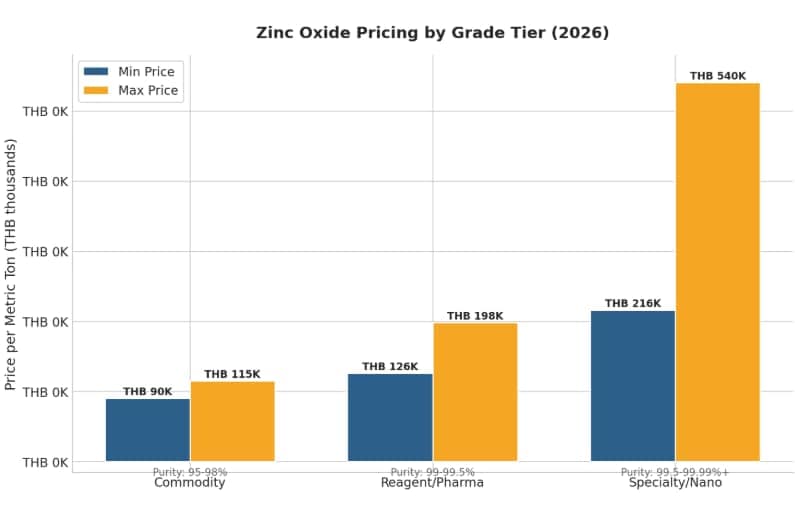
| Grade | Price (THB/MT) | Purity | MOQ | Best For |
| Commodity | 90,000-115,200 | 95-98% | 10-20 MT | Rubber, industrial coatings |
| Reagent/Pharma | 126,000-198,000 | 99-99.5% | 500 kg-5 MT | Pharmaceuticals, cosmetics, labs |
| Specialty/Nano | 216,000-540,000+ | 99.5-99.99%+ | 100 kg-1 MT | Sunscreens, electronics, R&D |
The 8-Step Sourcing Framework
Step 1: Define Technical Specifications
Translate end-use requirements into measurable parameters before contacting suppliers. Include tolerances and required documentation.
Step 2: Request Technical Documentation
- Technical Data Sheets with complete specification ranges
- COAs from 3-5 consecutive production lots
- Safety Data Sheets (GHS compliant)
- Quality Certificates (ISO 9001, 14001, GMP)
- Regulatory documentation (REACH, TSCA, DMF/CEP)
Step 3: Conduct Supplier Audits
Audit checklist:
| Area | Key Questions |
| Raw Material Controls | How are zinc sources qualified? |
| In-Process Monitoring | What critical control points are tracked? |
| Finished Goods Testing | Is every lot tested before release? |
| Traceability | Can you trace a lot to raw material batches? |
| Storage | Humidity control? Caking prevention? |
Step 4: Validate With Trial Lots
- Request production-batch samples (not lab-made)
- Run under actual production conditions
- Measure application-specific performance (cure time, SPF, sintering density)
- Compare supplier COAs against independent lab testing
- Plan 2-4 week pilot timeline
Reject suppliers if: Lot-to-lot variation exceeds tolerance or Cpk <1.33 on critical parameters.
Step 5: Analyze Total Cost Of Ownership
| Cost Element | Typical Range |
| Base Price | THB 90,000-540,000+/MT |
| Freight & Logistics | THB 7,200-28,800/MT |
| Testing & QC | THB 18,000-72,000/lot |
| Risk Costs | Variable (rework, downtime, recalls) |
Thailand lens: Paying a moderate premium for traceability and consistent COAs often reduces total cost of ownership.
Example: Supplier A at THB 108,000/MT with 4% rejection rate costs more overall than Supplier B at THB 122,400/MT with 0.5% rejection rate when factoring rework costs.
Step 6: Assess Supply Continuity
Verify: Production capacity vs. utilization, raw material security, inventory policies, lead time reliability, contingency plans.
Thailand advantages: 3-7 days domestic, 5-14 days ASEAN, reduced freight for regional buyers.
Step 7: Contractual Quality Guarantees
Essential clauses:
| Clause | Purpose |
| Acceptance Criteria | Define pass/fail standards with third-party lab arbitration |
| Non-Conformance Remediation | Replace/credit within 10 business days |
| Payment Holdback | 10% until arrival QC passes |
| Change Notification | 60-day notice for process/material changes |
| Audit Rights | Annual audits with 30-day notice |
| Indemnity | Supplier covers damages from non-conforming product |
Step 8: Evaluate Sustainability
Assess: Energy intensity (kWh/MT), emissions reporting, raw material sourcing, waste management, environmental permits.
Thailand vs. China/India: When Each Wins
| Priority | Thailand | China/India |
| Lead Time | 3-7 days domestic | 7-14+ days |
| MOQ Flexibility | Smaller orders accepted | Container loads required |
| Technical Support | Collaboration on trials | Minimal support |
| Unit Cost | Mid (value-added premium) | Lowest commodity pricing |
| Scale | Single-digit kilotonnes | Hundreds of kilotonnes |
Strategic takeaway: If lead time, traceability, or small-batch flexibility matters, Thailand wins. If raw unit cost on enormous tonnages is the primary driver, China/India may be more competitive. Total-cost advantages often emerge when factoring logistics, compliance, and quality control.
Risk Mitigation: Common Pitfalls
| Pitfall | Consequence | Mitigation |
| Price-Only Selection | THB 500,000+ in disruptions | Evaluate total cost of ownership |
| Skipping Trial Lots | Performance gaps | Run 2-4 week pilots |
| Single-Source Dependency | Supply disruption | Dual-source critical grades |
| No Change Notification | Unannounced process changes | 60-day notice clause |
| Poor Storage | Caking in tropical humidity | Silica gel, moisture-control liners |
Logistics And Packaging
| Consideration | Guidance |
| Packaging | FIBC (1 MT) for bulk; drums/sealed liners for cosmetic/pharma |
| HS Code | 2817.00 (verify with customs broker) |
| Storage | <25°C, <60% RH; moisture-control liners for tropical climate |
| Third-Party Labs | SGS, Intertek, reputable regional labs |
Conclusion
Sourcing zinc oxide today requires a stronger focus on purity, consistency, and application-specific performance rather than simply securing supply. As technical requirements continue to evolve across industries such as coatings, ceramics, and personal care, the ability to deliver controlled quality and reliable specifications becomes essential for long-term success.
At Global Chemical, we specialize in producing a full range of zinc-based materials, including Active Zinc Oxide, Zinc Oxide BP and USP grades, Nano Zinc Oxide, Zinc Carbonate, Zinc Ammonium Chloride, and Zinc Sulfate. Operating within Thailand’s Zinc oxide landscape, we combine decades of manufacturing experience with consistent quality control to deliver high-performance materials at competitive pricing. By focusing on stability, precision, and supply reliability, we support our partners in achieving dependable product performance and scalable growth.
FAQ
1. What is zinc oxide used for?
Zinc oxide is used in many industries, including rubber production, cosmetics, paints, and ceramics. It helps improve durability, protection, and overall product performance.
2. What affects the quality of zinc oxide?
Key factors include purity level, particle size, moisture content, and the presence of heavy metals. Even small variations can impact performance depending on the application.
3. How do I choose the right grade?
It depends on your use:
- Industrial use → standard grades
- Cosmetics or pharma → high-purity grades
- Specialized applications → treated or custom grades
4. Why is consistency important between batches?
Inconsistent batches can cause production issues such as curing problems in rubber, color defects in ceramics, or reduced performance in coatings.
5. What documents should a supplier provide?
A reliable supplier should provide:
- Certificate of Analysis (COA)
- Technical Data Sheet (TDS)
- Safety Data Sheet (SDS)
- Relevant certifications (ISO, GMP if required)
6. Can zinc oxide be customized?
Yes. Many suppliers offer customization such as particle size control, surface treatment, and formulation adjustments to match specific application needs.
7. What are common problems when sourcing zinc oxide?
Common issues include:
- Poor batch consistency
- Incorrect particle size
- Moisture-related clumping
- Lack of proper documentation
8. How should zinc oxide be stored?
Store in a cool, dry place with sealed packaging to prevent moisture absorption and clumping.
9. Is it necessary to test before large orders?
Yes. Running trial batches helps confirm performance and ensures the material works with your production process before committing to bulk orders.
10. What is the safest sourcing approach?
The best approach is to:
- Clearly define specifications
- Test multiple suppliers
- Use a backup supplier
- Focus on long-term reliability, not just price